It’s October 3, 2025, and the federal government shut down two days ago for lack of budget legislation. It was not a surprise. Republicans holding power in the House of Representatives, the Senate, and the White House have made it a point not to negotiate a resolution, either among themselves (they had the power to resolve this all by themselves) or with the opposition party.
Citizens in the United States are becoming so used to dysfunctional federal government that the whole affair was met with a collective yawn on October 1. The pain will not hit immediately, and, when it does, most citizens believe it will not fall directly upon themselves.
Citizens in the United States have become so self-indulgent that pain which does not fall directly upon themselves does not matter.
In that context, all the follows may be a waste of time and computational effort. What follows is a quick look at the ongoing costs of a federal government shutdown on the state of Iowa. Iowa was picked because I am familiar with the data and I have a recently constructed economic impact model for Iowa. Similar calculations could certainly be done for any state.
The analysis will be done on the basis of a one-day shutdown. Results can be multiplied by the number of days the shutdown lasts to approximate total costs to the Iowa economy. Wherever possible, I will try to bring effects back to numbers of jobs lost.
To put this in perspective, over the past ten years, from December 2014 to December 2024, Iowa had a net gain of just 10 nonfarm jobs per day. Over the past year, from December 2023 to December 2024, Iowa had a net loss of 15.5 nonfarm jobs per day.
Federal Jobs
The first loss Iowa will see from a shutdown is the idling of federal employees. Iowa has about 18,400 federal civilian employees (Bureau of Labor Statistics – BLS). Most of them will be idled as nonessential workers. These employees generate an Iowa payroll of a little over $524,000 per workday (Bureau of Economic Analysis (BEA) and BLS). Like the rest of us, they spend their earnings on groceries, cars, clothes, dance lessons, and what-not.
When that payroll money does not get spent, someone else in Iowa doesn’t receive it. In general, taking half a million dollars out of Iowa payrolls will result in a loss of about 3.5 jobs. That means Iowa can expect to lose 3.5 jobs for every day the shutdown lasts. This is in addition to the 18,400 federal workers idled by the shutdown. This is a loss to the rest of us because those federal workers are not being paid and are not spending their earnings in the local economy.
Remember, over the past ten years, Iowa has generated only ten new nonfarm jobs per day.
Finally, this is not just workers. Idling federal workers will cost Iowa nearly $150,000 in business earnings (profits, rents, interest, etc.) for every day the shutdown continues. This is entirely from the effects of the unspent federal payrolls. This does not include the losses of federal contract or supply receipts or federal direct payments.
Direct Farm Payments
According to the Environmental Working Group, Iowa farmers received $43.5 billion dollars in direct payments over the past 30 years. This works out to an average of nearly $4 million per day, ever day, over the period. Because crops have already been cultivated this year, this is also best looked at as a subtraction from farm family incomes.
If we remove these sums from farm family incomes, farm families, like the federal employees above, will not be able to spend their funds on cars, houses, groceries, and what-not. This drop in expenditures means other Iowa families will not receive these expenditures as income.
The result of all of this is that reducing farm family expenditures by $4 million will reduce Iowa’s total employment by 26 jobs. It will reduce Iowa business earnings by $1.1 million.
On average, this will happen every day of the shutdown. The model is linear. The results can be multiplied by the number of days the shutdown lasts.
Remember, this will be in addition to the initial $4 million daily loss in farm family income.
Social Security Benefits
According to the BEA, Iowans received $15.5 billion in Social Security payments during 2024. This works out to an average of $42.5 million per day. This, too, is an addition to family income. When it does not arrive, recipients do not spend it on groceries, medical care, vacations, cars, and what-not. This reduces the incomes of Iowans who would normally supply these things to the recipients.
Reducing Iowa household income by the loss of daily potential Social Security payments would cost Iowa 278 jobs for every day that a shutdown stops Social Security payments. It would also cost Iowa businesses $11.7 million in lost earnings – every day that Social Security payments are not received. This is on top of and completely separate from the hardships imposed on Social Security recipients.
Medicare and Medicaid
The BEA reports that Medicare and Medicaid pumped $19.5 billion into the Iowa healthcare industry in 2024. This averages $53.2 million per day.
Unlike the impacts calculated above, these sums are not properly looked upon as changes to household income. Medicare and Medicaid payments are direct purchases of services from the healthcare industry.
Splitting these expenditures across the segments of the healthcare industry in Iowa results in a loss of 612 jobs for every day’s loss in Medicare and Medicaid expenditures in Iowa. It also results in the lose of approximately $21.7 million in business earnings across the state.
These estimates can be multiplied over the days payments are eliminated during a government shutdown.
These estimates are above and beyond the hardships imposed on recipients who are denied healthcare, and they are above and beyond additional costs that result from healthcare being denied.
Roll It All Together
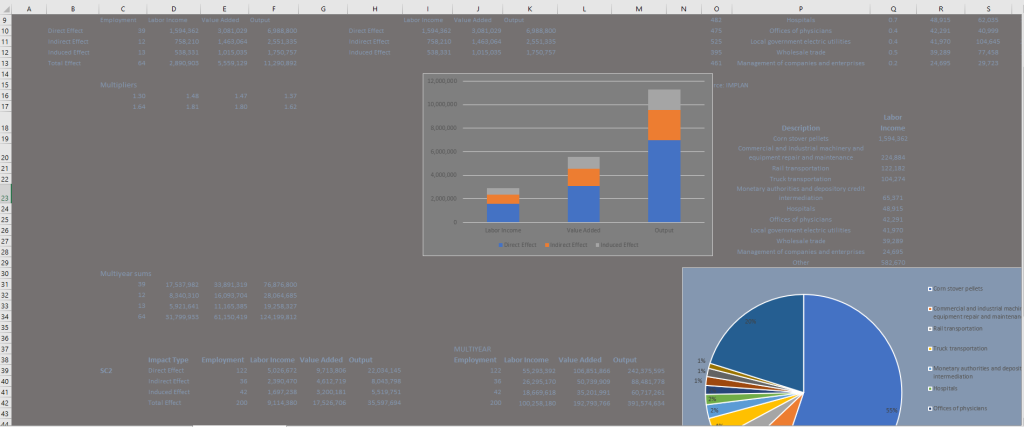
Summing up the impacts laid out above, each day’s loss of the federal funding would cost 920 jobs and $34.6 million in business earnings. This would be above and beyond the direct loss of incomes and services to the initial recipients of the funds.
This would be multiplied every day receipts and services are lost due to a federal government shutdown.
Unlike a layoff at John Deere or some other manufacturer, however, these losses will be spread across businesses throughout Iowa and will not be reported to the Iowa Department of Workforce Development as mass layoffs. They will not be reported in the media the same way a mass layoff would be reported.
It will start as reduced hours, lost shifts, and scattered individual job losses, but the steady march of reduced expenditures, incomes, and employment will be insidious. The victims will be largely invisible except to their own small circles of family and friends.
And On and On and On We Go
Without going on ad nauseum, this is not all of it. According to Common Good Iowa, in 2024
- The USDA spent $916.6 million in Iowa beyond direct farm payments
- The Department of Commerce spent $1.4 million
- The Department of Education spent $676 million
- The Department of Energy spent $7.6 million
- The Environmental Protection Agency spent $139.1 million
- The Department of Health and Human Services spent $795.4 million in addition to its Medicaid outlays
- Homeland Security spent $11 million
- Housing and Urban Development spent $77.2 million
- The Department of the Interior spent $30.5 million
- The Justice Department spent $17.3 million
- The Department of Labor spent $60.2 million
- The National Endowment for the Arts and Humanities spent $1.9 million
- The Department of Transportation spent $934.6 million
It all totals another $3.77 billion in federal spending in Iowa – an average of over $10 million per day. All of this could also be allocated to industries and run through an economic impact model, but you get the idea.
Most of us won’t directly feel the effects of a federal shutdown unless it lingers for some time. Although scattered, however, those impacts are larger on a daily average basis than the largest mass layoff reports that regularly make headlines in Iowa.
The invisibility of the victims magnifies the cruelty of these impacts and the irresponsibility of the people who made the shutdown a reality.